Product Carbon Footprint
Insight as the basis for sustainability
Ecological

Product Carbon Footprint
At Koppert Cress, we work every day to reduce our impact on the climate and the environment. Insight is essential if we are to make targeted improvements. That is why we have been calculating our Corporate Carbon Footprint (CCF) – our organisation’s total emissions – for many years.
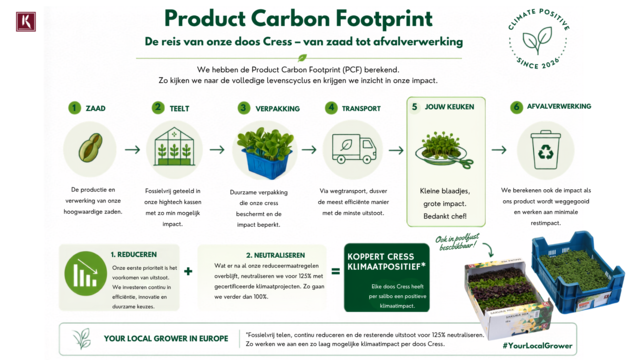
However, as not every product has the same impact, we wanted to be able to manage this even more precisely. That is why we have also developed a Product Carbon Footprint (PCF) for our products. This involves mapping the total greenhouse gas emissions throughout a product’s entire life cycle: from the seed right through to the waste disposal of the packaging (or ‘cradle-to-grave’).
From seed to waste disposal
The Product Carbon Footprint examines all stages in the supply chain that contribute to greenhouse gas emissions. For a box of Cress, this includes, amongst other things:
- The production and transport of our seeds
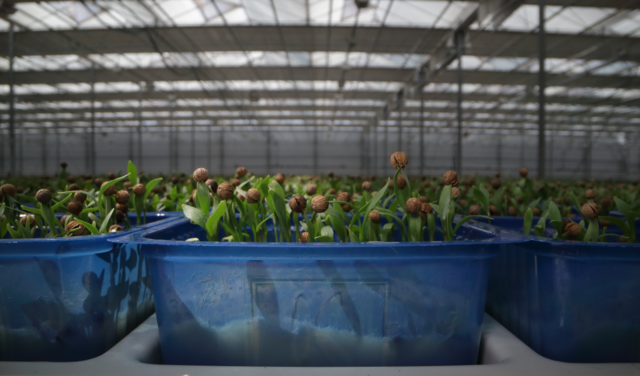
- Cultivation in our greenhouses in Monster
- The production of packaging materials
- Transport to the final destination
- Use and storage in professional kitchens
- Waste disposal of the packaging in the country of destination
By providing insight into the entire supply chain, we can identify where the greatest impact lies and where further reductions are possible. In this way, the Product Carbon Footprint helps us to make informed choices and make our products more sustainable, step by step.
Reduce first, then neutralise
Our primary aim is not to offset emissions, but to prevent them as much as possible. That is why we are constantly investing in making our business operations more sustainable. Since 2026, we have been growing our crops without the use of fossil fuels, which has significantly reduced emissions from our own cultivation. In addition, we continue to invest in more efficient processes, more sustainable packaging and further reductions in our CO₂ emissions.
Our Product Carbon Footprint shows that road transport accounts for only a small proportion of the total emissions associated with a box of Cress. Here too, we continue to seek further improvements and more efficient logistics solutions wherever possible.
More than just cutting back
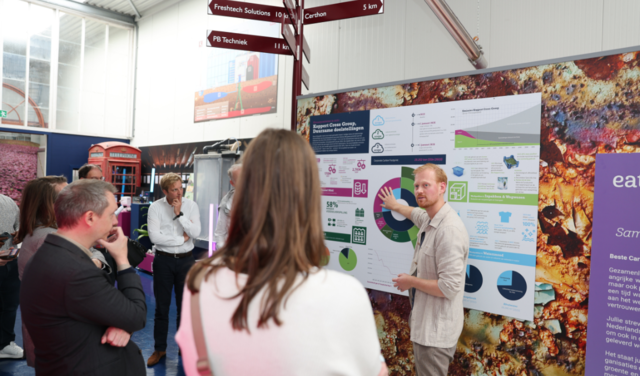
After all reduction measures have been implemented, a limited amount of emissions remains. We offset these remaining emissions by 125% through certified climate projects that correspond to the main sources of emissions within our business operations and value chain. For example, to address the remaining emissions from road transport, we have invested in an equivalent amount of certified emission reduction credits via CarbonLeap. In addition, we are investing in CO₂ storage through regenerative agriculture (Horaholm/Erwin Westers), carbon sequestration in rock (Erfgoed), bio-based insulation materials made from hemp (GreenDutch), and nature restoration and reforestation through Tree-Nation. Where possible, we tailor our investments to the nature and scale of our remaining emissions. In doing so, we go beyond simply reducing our own emissions and actively contribute to a climate-positive future.
Our fossil-free cultivation in Monster and efficient road transport across Europe enable us to reach many capital cities without significant emissions. Combined with offsetting our remaining emissions, this forms the basis of our ambition as Your Local Grower in Europe.
Every box of Cress therefore represents a combination of flavour, health and the lowest possible climate impact. By continuously measuring, reducing and taking responsibility for our remaining emissions, we are working every day towards a more sustainable food supply chain.
Sustainable stories
Introduction
Powerful stories that capture the essence of our natural world: sustainability at every level and in every aspect.
-
Ecological
Product Carbon Footprint: an insight into the emissions from a box of Cress
Product Carbon Footprint: insight into the emissions from a box of Cress
At Koppert Cress, we work every day to reduce our impact on the climate and the environment. Insight is essential if we are to make targeted improvements. That is why we have been calculating our Corporate Carbon Footprint (CCF) for many years: the total emissions of our organisation.
However, as not every product has the same impact, we wanted to be able to manage this even more precisely. That is why we have also developed a Product Carbon Footprint (PCF) for our products. This involves mapping the total greenhouse gas emissions throughout a product’s entire life cycle: from the seed right through to the waste disposal of the packaging (or ‘cradle-to-grave’).
-
Ecological
Koppert Cress's climate goals validated by SBTi
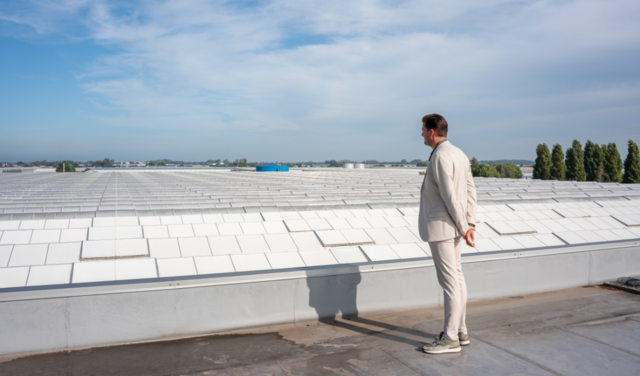
Sustainability requires more than just ambition. That is why Koppert Cress had its climate targets validated by the Science Based Targets initiative (SBTi). This independent organization assesses whether climate targets are aligned with the latest climate science and contribute to limiting global warming. With this validation, the SBTi confirms that Koppert Cress’s climate targets are specific, measurable, and aligned with international climate goals.
-
Social
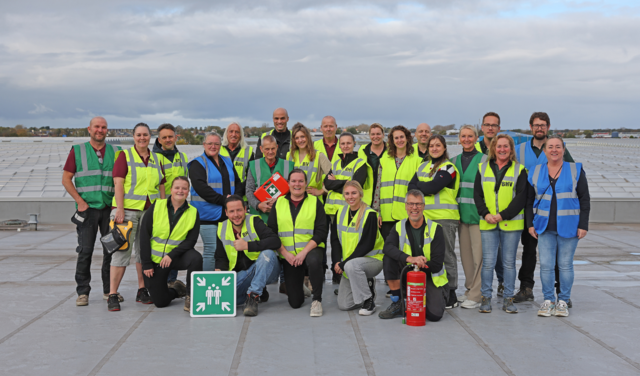
Working Together in an Inclusive Organisation
Why is building trust so important to us? Trust shows someone that we believe in their abilities, intentions and dedication to contribute to a shared goal.
-
Social
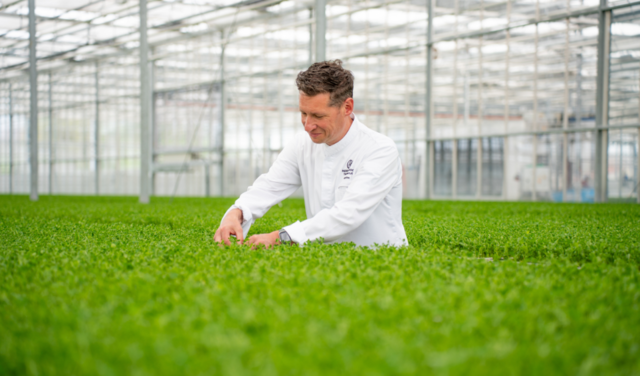
Learning to Change: Connecting Healthy Food, Education and Gastronomy
Koppert Cress and Hotelschool The Hague demonstrate how education, gastronomy and horticulture can strengthen one another. With storytelling as a connecting force, they bring the origin, value and experience of food to life — inspiring the next generation to contribute to a healthier food future.